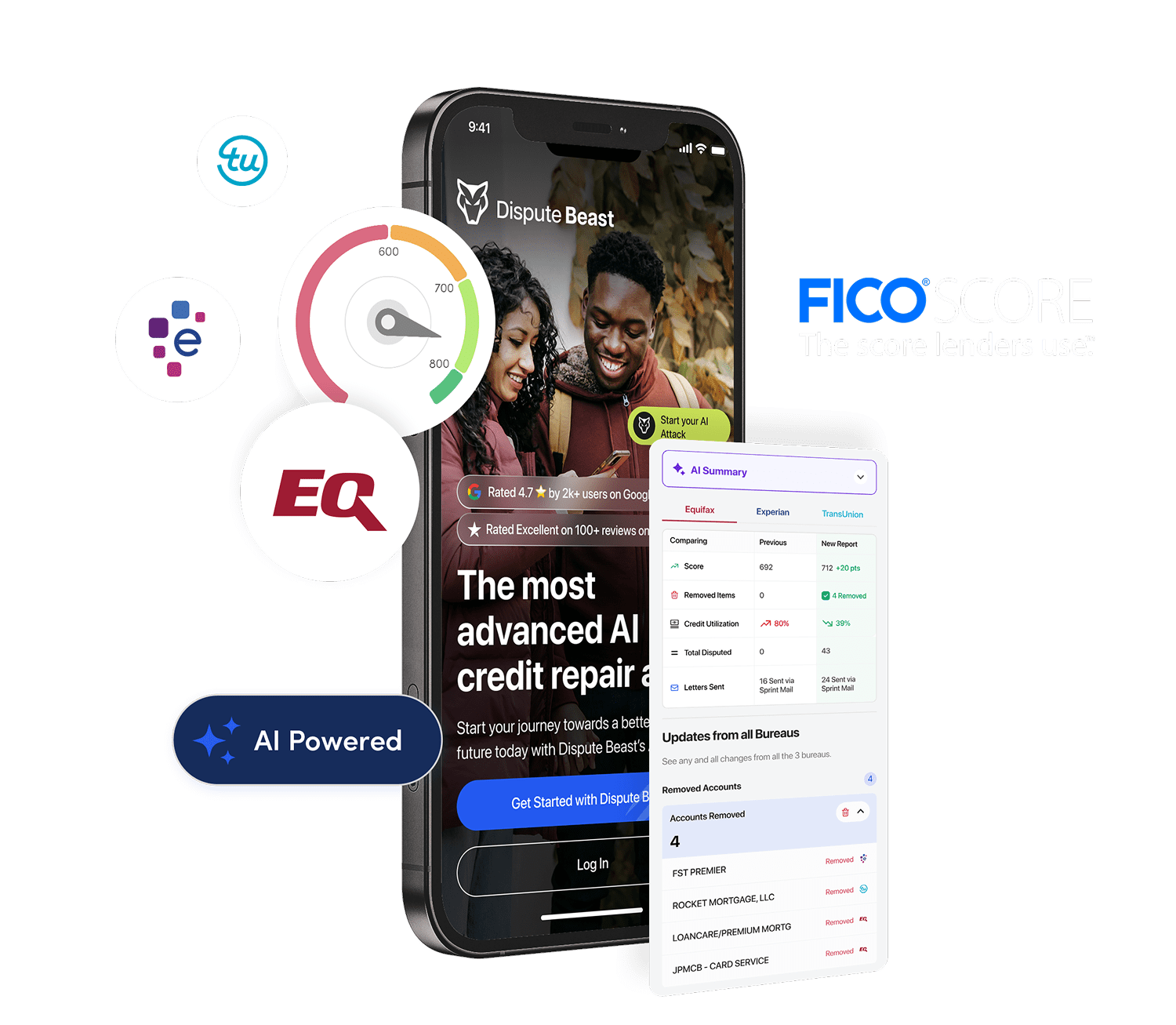


The credit dispute landscape has changed dramatically over the last decade. Traditional credit repair methods—handwritten letters, template-based disputes, manual credit reviews—were once the standard. But in 2026, the introduction of artificial intelligence has accelerated results, improved accuracy, and transformed how consumers approach credit report errors.
This article answers the question everyone in the credit industry is asking: Which method actually fixes credit errors faster—AI or traditional disputes?
We’ll break down timelines, accuracy differences, compliance factors, success rates across error types, and how AI-powered platforms like Dispute Beast are redefining the dispute ecosystem.
If you’re part of the 79% of Americans who have at least one credit report error in their lifetime, understanding the differences between these two methods is essential for choosing the fastest and most reliable path to results.
AI Credit Disputes: Why They’re Changing the Industry
What Makes AI Faster?
AI accelerates credit dispute timelines by automating the stages that traditionally cause delays: scanning reports, identifying inaccuracies, classifying dispute types, and drafting letters. These steps, which once took hours or days, now happen instantly thanks to automated logic and machine learning.
AI is not “guessing.” It scans the credit report line-by-line using pattern recognition, Metro 2 logic, and regulatory standards. This mirrors consumer protection principles outlined in the CFPB’s Regulation V, which governs accuracy obligations in credit reporting.
Where traditional reviewers rely on experience, AI relies on structured data—and that difference fuels speed.
Traditional Credit Disputes: Still Effective, But Slower
How Traditional Disputes Work
Before AI, credit repair companies ran on manual workflows:
- Human review of the credit report
- Manual identification of errors
- Drafting letters by hand or using templates
- Mailing disputes round-by-round
- Waiting for bureau responses
While still compliant and effective, this method slows dramatically because every step depends on the speed, accuracy, and time availability of the reviewer.
Humans get tired. AI does not.
And when thousands of consumers request disputes, traditional methods simply cannot scale.
Timeline Comparison: AI vs. Traditional Disputes
The core question: Which resolves errors faster?
AI Dispute Timelines
AI speeds up every step that occurs before mailing:
- Scanning the credit report: Instant
- Error detection: Seconds
- Classification of violation type: Seconds
- Drafting letters: Seconds
- User approval & mailing: 5–10 minutes
This means the dispute can be in the mail on the same day the user loads their credit report.
Traditional Dispute Timelines
Manual methods are significantly slower:
- Scanning: 1–2 hours per report
- Error identification: Up to several days
- Drafting letters: 1–2 hours
- Corrections or rewrites: Additional delays
Traditional disputes often take several days before the first round of letters is even mailed.
Once mailed, both methods follow the same federal investigation timelines governed by FCRA—typically 30 to 45 days according to the FTC’s Fair Credit Reporting Act guidelines.
Accuracy Comparison: Why AI Wins on Precision
AI Is Designed for Pattern Recognition
AI examines the credit report using thousands of known error patterns. This makes it especially powerful for:
- detecting duplicate accounts
- identifying mixed file data
- spotting re-aged or outdated debt
- finding incorrect payment statuses
- flagging unauthorized inquiries
The accuracy advantage comes from the ability to compare large datasets instantly—something humans cannot replicate manually.
This capability aligns with consumer reporting insights found in NerdWallet’s analysis of credit reporting behaviors, which highlights how frequent and subtle reporting inconsistencies can be.
Traditional Review Relies on Human Judgment
Traditional reviewers may miss small inconsistencies, especially in large or complex credit files. They can also incorrectly classify errors, which weakens the dispute and increases the chance of verification.
Success Rate Comparison: Where AI Outperforms Traditional Disputes
Cases Where AI Achieves Faster and Higher Success Rates
AI performs best in disputes that are:
- factual
- objective
- easily verifiable
These include:
- duplicate accounts
- incorrect payment status
- outdated balances
- unauthorized inquiries
- re-aged accounts
AI can detect and challenge these issues more aggressively because it pinpoints the exact line of data that violates reporting standards.
Many users see major improvements in the first two rounds because the errors are clear-cut.
Success Rate Comparison: Where Traditional Disputes Perform Similarly
Some disputes require manual escalation, police reports, or fraud documentation. In these cases, AI and traditional disputes perform similarly.
Examples Where Both Methods Produce Similar Outcomes
- identity theft cases involving active fraud
- bankruptcies and public records
- authorized accounts with late payments
- complex cases involving legal disputes with creditors
These scenarios depend on external investigation teams and supporting documentation, so AI cannot accelerate the process.
Error Types: Which Method Fixes Each Kind Faster?
AI Dominates These Categories
- Duplicate tradelines (AI identifies structural similarity instantly)
- Incorrect payment dates or statuses
- Balance inaccuracies
- Account ownership errors
- Unverified inquiries
Traditional Methods Hold Up in These Categories
- fraud on open accounts
- court-issued judgments or liens
- bankruptcy reporting
- complex debt disputes
Because these require external validation, both methods face the same federal investigation timelines.
Compliance: Why AI Reduces Human Mistakes
AI Letters Are More Consistent with Federal Standards
AI dispute letters reference the correct sections of FCRA, FDCPA, and Metro 2 standards. This avoids the compliance mistakes that slow down many manual disputes.
AI follows logic similar to frameworks outlined by the CFPB’s consumer tools for disputing errors, reinforcing strong compliance.
Traditional Disputes Risk Human Error
Mistakes like incorrect wording, missing details, or incomplete documentation can weaken dispute letters. AI solves this by enforcing consistent language based on violation type.
Cost Comparison: AI vs. Traditional Credit Repair
AI Is Often More Affordable
AI-driven platforms eliminate labor-heavy costs, allowing consumers to access enterprise-grade dispute logic for low monthly fees.
Traditional repair services often charge:
- $79–$129 per month
- setup fees
- per-round billing
AI platforms automate all of this with predictable pricing—especially platforms like Dispute Beast where the software is free with credit monitoring.
Learn the Foundation Behind Error Reporting
To understand why certain errors matter more and how they damage your score, review the full guide: Credit Report Errors: The Hidden Problem Hurting Your Score.
Which Method Is Better Overall?
AI Wins for Speed, Accuracy, and Consistency
AI achieves faster pre-mailing preparation, higher accuracy in detection, more consistent classification, and a fully automated 40-day dispute cycle. It resolves factual errors significantly faster than traditional methods.
Traditional Disputes Still Work for Complex Cases
But traditional disputes remain valuable for fraud, legal disputes, or cases requiring external verification—they simply take longer.
How Dispute Beast Uses AI to Deliver Faster Results
Dispute Beast automates the full AI workflow using:
- a three-level attack strategy targeting bureaus, furnishers, and secondary bureaus
- 40-day automated scanning cycles
- compliance-based dispute drafting
- integrated FICO 8 and Vantage 3.0 monitoring
Users simply upload their report, click one button, mail letters, and let the AI take over. It’s faster, more precise, and more consistent than any traditional method.
If you’re ready to use AI instead of outdated methods, start your free Dispute Beast account today and launch your first automated dispute round with one click.